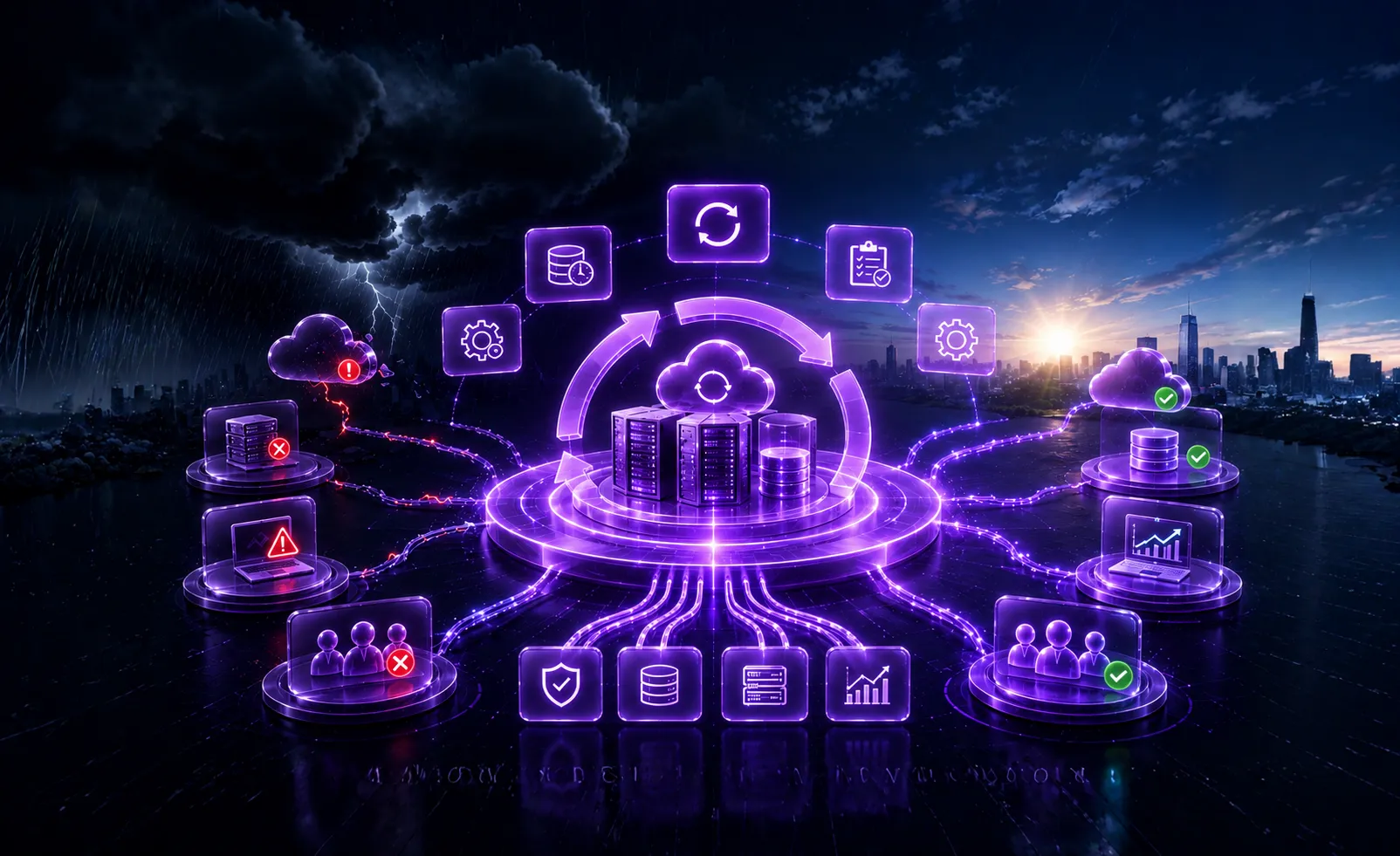
Every organization prepares for growth.
Fewer prepare for disruption.
Yet disruptions are no longer rare events.
Cyberattacks, cloud outages, hardware failures, ransomware incidents, configuration errors, and human mistakes can interrupt operations with little warning.
The question is no longer whether downtime will occur.
The question is how quickly your organization can recover when it does.
For many enterprises, recovery speed has become the true measure of operational resilience.
Organizations that recover quickly minimize business impact, protect customer trust, and maintain competitive momentum.
Those that recover slowly often face financial losses, productivity disruptions, reputational damage, and prolonged operational instability.
In today's digital economy, resilience is not defined by avoiding disruption.
It is defined by recovery readiness.
Downtime Is Inevitable. Prolonged Downtime Is Not.
Technology environments have become increasingly interconnected.
Applications depend on cloud platforms. Business processes rely on real-time data. Customer experiences depend on service availability.
As complexity grows, so does the possibility of failure.
Even organizations with strong infrastructure investments experience:
The difference lies in recovery execution.
Organizations with strong business continuity planning can restore services rapidly.
Others spend valuable hours identifying dependencies, locating backups, and coordinating response efforts.
The result is a widening resilience gap.
The Cost of Slow Recovery
Many enterprises focus heavily on preventing downtime.
Prevention matters.
Recovery matters more.
A delayed response can create:
For industries such as BFSI, healthcare, manufacturing, and government, even short interruptions can have significant consequences.
This is why recovery time objectives and recovery point objectives have become critical business metrics.
Recovery performance directly impacts business outcomes.
Downtime Is More Expensive Than Most Organizations Realize
Every minute of downtime carries a business cost.
The impact extends far beyond lost productivity.
Industry studies estimate that the average cost of enterprise IT downtime can range from $5,000 to more than $9,000 per minute, depending on the industry and the criticality of the affected services.
Research also shows that unplanned outages often result in:
A single disruption can quickly escalate into a business crisis.
The financial equation is simple:
The longer the recovery, the greater the business impact
This is why leading organizations increasingly view disaster recovery investments not as insurance costs but as business continuity investments.
Faster recovery helps organizations:
Recovery speed has therefore become both a resilience metric and a business performance metric.
What Separates Fast-Recovery Organizations?
Recovery speed is rarely determined during a crisis.
It is determined long before disruption occurs.
High-performing organizations typically invest in four foundational capabilities.
1. Disaster Recovery Readiness
Effective disaster recovery planning ensures systems, applications, and data can be restored quickly.
Organizations with mature disaster recovery readiness maintain:
Recovery becomes predictable rather than reactive.
2. Infrastructure Resilience
Recovery begins with infrastructure resilience.
Organizations that prioritize resilient environments reduce single points of failure through:
This enables faster service restoration during disruptions.
3. Operational Visibility
Teams cannot recover what they cannot see.
Operational visibility provides real-time awareness of:
Organizations with stronger visibility often reduce troubleshooting time and improve response effectiveness.
4. SLA-Driven Accountability
Recovery improves when accountability is clearly defined.
Organizations operating with SLA-driven operations establish:
This eliminates confusion during critical incidents and accelerates decision-making.
The Orient Recovery Readiness Framework
Organizations that recover quickly typically excel across five critical pillars.
Visibility
Understand application dependencies, infrastructure health, and business impact.
Resilience
Build redundancy and eliminate single points of failure.
Automation
Implement recovery automation for failover, backup validation, and recovery workflows.
Accountability
Establish clear ownership through SLA-driven operations.
Continuous Improvement
Regularly test recovery procedures and refine response plans.
Organizations that strengthen these pillars recover faster because recovery becomes a planned capability rather than an improvised response.
Recovery Speed and Business Continuity
Many organizations view business continuity planning as a compliance exercise.
Leading enterprises view it as a strategic advantage.
A strong business continuity strategy enables organizations to:
The objective is not simply restoring systems.
The objective is restoring business outcomes.
Recovery speed becomes a competitive differentiator.
The Role of Managed Recovery Operations
As environments become more complex, managed recovery operations become increasingly important.
Organizations often struggle with:
This is where unified IT ownership creates a significant advantage.
A One SLA, One Partner model provides:
Instead of coordinating multiple vendors during a crisis, organizations can focus on restoring business operations.
Recovery becomes faster because responsibility is clear and decision-making is streamlined.
In modern enterprises, resilience is not only about technology.
It is also about operational accountability.
Final Thought
Rain is inevitable.
Storms are unavoidable.
Technology disruptions will occur regardless of how sophisticated an environment becomes.
What separates resilient organizations from vulnerable ones is not their ability to avoid disruption.
It is their ability to recover quickly.
Organizations that invest in disaster recovery readiness, infrastructure resilience, operational visibility, and SLA-driven accountability are better positioned to maintain continuity when disruptions occur.
Because when the downpour arrives, recovery speed becomes the metric that matters most.
And resilience is measured not by how systems fail but by how quickly they return to service.